May 2026
Presentation Is a Layer That Is No Longer Needed
The Layer We Built
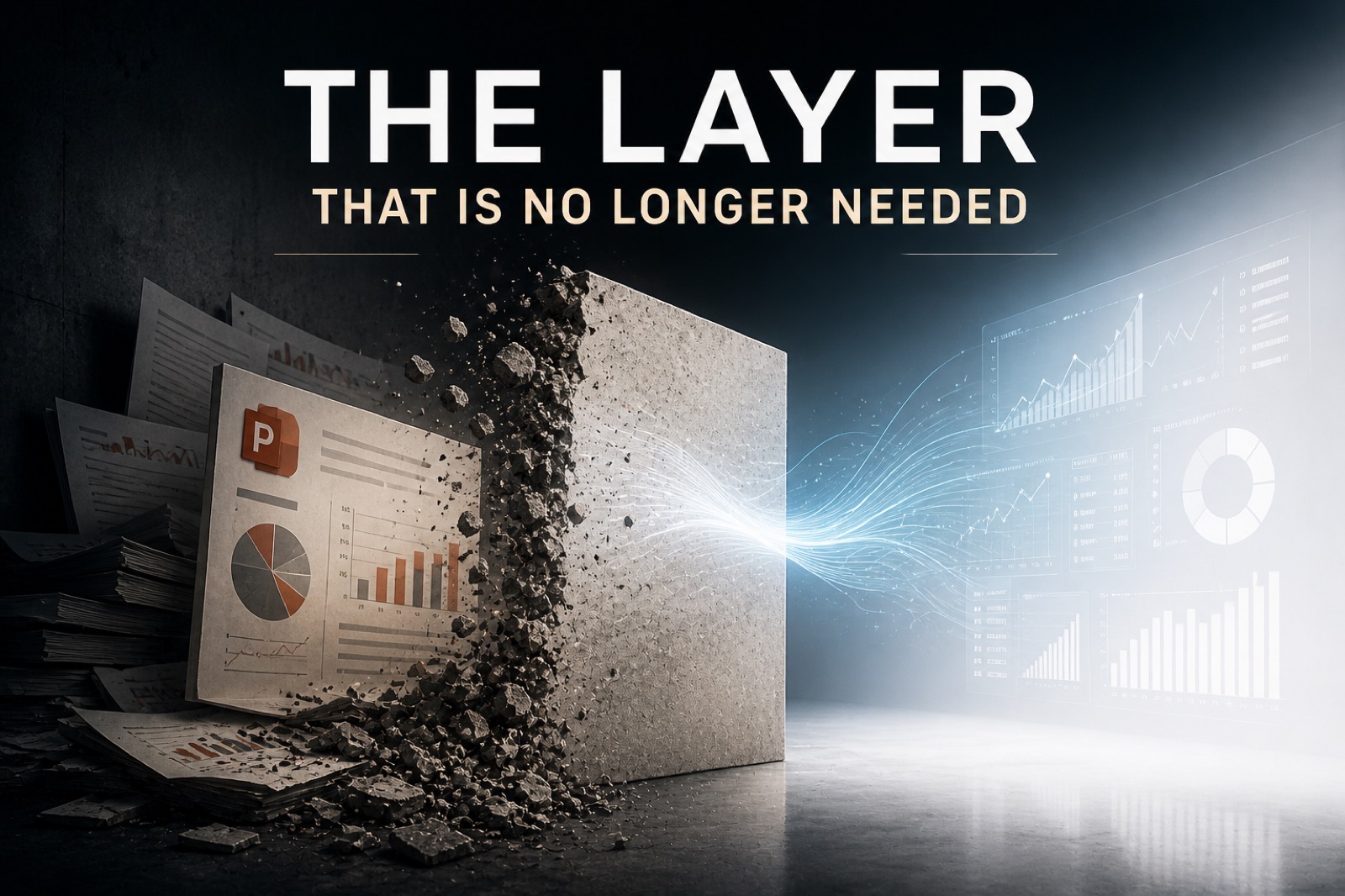
Reports and presentations were never final outcomes. They were an added layer.
As data became more abundant and complex, organizations needed a way to process it before it reached decision-makers. Raw numbers and fragmented inputs weren't enough on their own. Someone had to interpret, structure, and shape that information into something usable.
Over time, this became the system. Data didn't move directly to decision-makers; it was filtered, reduced, and organised before it ever reached them. What looked like a report was not just a summary, but a processed version of reality, compressed into something that could be consumed quickly.
And for a long time, that made sense. Without this layer, data was too messy, too dense, and too unstructured to act on. So reports and presentations became the bridge between information and action, quietly defining how decisions were made.
When Alignment Starts to Drift
As this layer became the norm, it began to do more than simplify information. It started to shape it. Every report is the result of a series of choices. What data is included, what is left out, what is emphasised, and how everything is arranged. By the time it reaches a decision-maker, the information has already been interpreted and structured in a particular way, carrying a built-in direction.
This is where reports move beyond being useful and become influential. What feels like clarity is often a guided view of the problem. The structure of a report does not just present information, it frames it. Some metrics appear more important because they are highlighted, some conclusions feel more obvious because the narrative leads towards them, and other perspectives disappear simply because they were never included.
The effect is subtle, which is why it has gone largely unquestioned. Reports feel objective because they are grounded in data, but the way that data is organised is not neutral. Order, emphasis, and omission all play a role in shaping how a situation is understood.
This works as long as the person creating the report fully understands the business goals and is aligned with the direction the organisation is taking. In reality, that alignment is rarely perfect, and I have built and sat through enough reports to know how easily it slips. A hands-on operator working closely with the data may find certain signals more valuable based on immediate context, while an expert might prioritise entirely different patterns based on experience. As information moves upwards through the organisation, these priorities shift again. What matters at an operational level does not always match what matters to mid-level management, and by the time it reaches senior leadership, the lens has changed once more.
In that process, data is not just organised, it is filtered through layers of perspective. Information that is dismissed early as less important may, in a different context, be exactly what a decision-maker needs. But that data never makes it through. Not because it is irrelevant, but because it was not seen as important at the point where the report was built.
The limitation is not the data itself, but the dependency on a single interpretation of it. Decision-makers are not just relying on data. They are relying on what someone else decided was worth showing.
And that is where the gap begins.
When the Layer Becomes Unnecessary
For a long time, this dependency on reports was unavoidable. Data had to be processed, interpreted, and structured before it could be used. There was no practical way for decision-makers to engage directly with raw information at scale, so analysis always began from a pre-built perspective.
That is what begins to change with AI.
The starting point is no longer a report. It is the data itself. Instead of relying on a structured output created by someone else, decision-makers can begin with a blank canvas and build their own understanding by interacting with the data in real time.
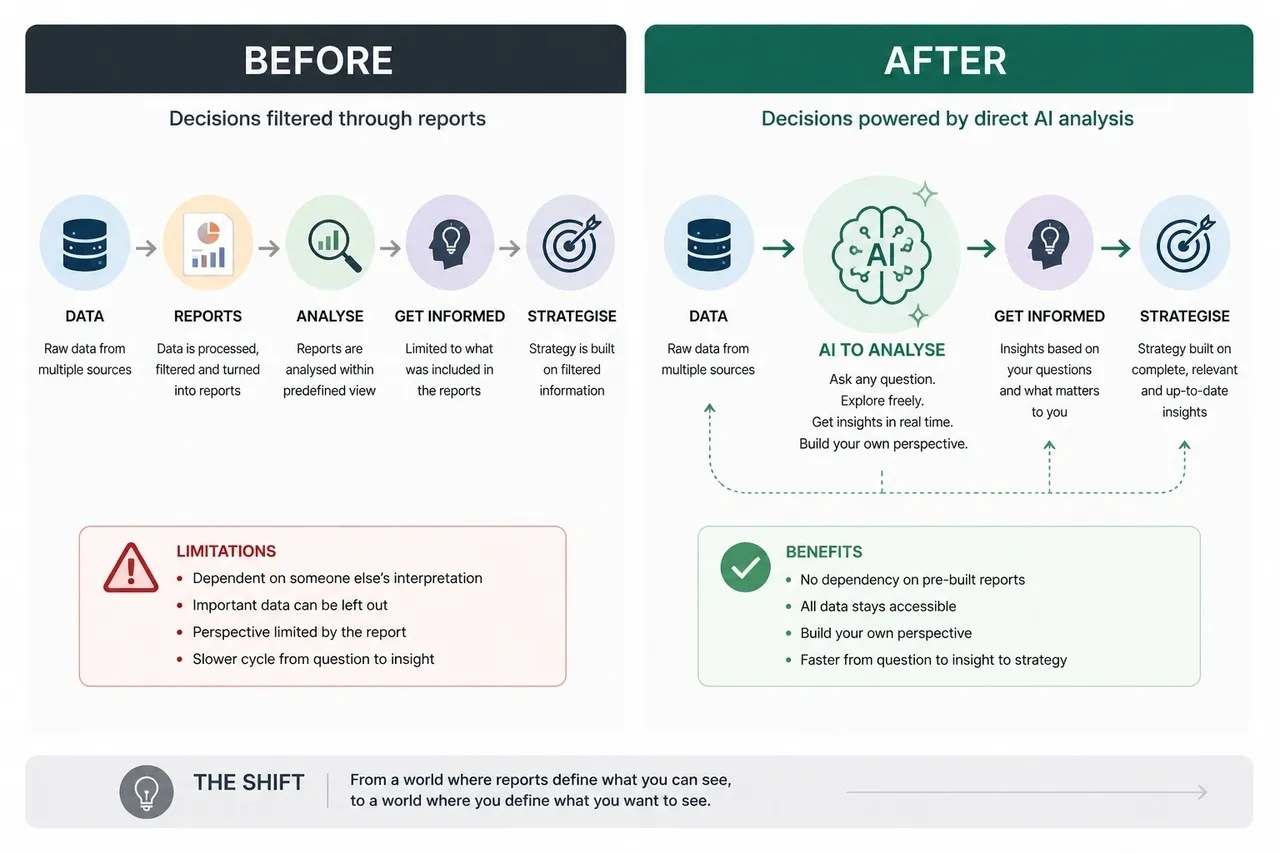
Earlier, the flow was linear. Data moved into reports, reports were analysed, insights were extracted, and only then did strategy take shape. Each step depended on the one before it, and the report defined the boundaries of what could be seen and understood.
With AI, that sequence collapses. Data can be analysed directly, questions can be asked as they arise, and insights can be generated in context. Understanding stops being something handed to you in a report. It becomes something you build as you go.
The layer's whole purpose changes. It is no longer there to predefine perspective, because perspective can now be built on demand. What was once filtered and fixed can now be explored and reshaped continuously.
The dependency does not shift from one format to another. It disappears.
And when that happens, the layer that once connected data to decisions begins to lose its place entirely.
When Meetings Stop Being Presentations
If this shift holds, the biggest visible change will not be in tools, but in how people come together to make decisions.
Meetings today are structured around reports. One person presents, everyone else listens, and understanding is built around what is shown. Most of the time is spent walking through a pre-built narrative, with a small window at the end for questions. By the time those questions come up, the direction has already been set.
That structure begins to break when the report is no longer the starting point.
When data is accessible and analysis can happen in real time, meetings no longer need to revolve around a single person presenting a fixed view. Instead, they shift towards collective exploration. People come in with context and intent, prepared to discuss, challenge, and arrive at decisions rather than passively "seeing the data" for the first time.
This changes the energy in the room. Conversations move faster, because everyone is already thinking in terms of outcomes. Observations can be tested immediately, different perspectives can be explored without delay, and decisions can begin to take shape during the discussion itself rather than after it.
In the current model, meetings often end with limited clarity on next steps, requiring follow-ups to translate discussion into action. In this new model, the gap between insight and action starts to close. The expectation shifts from understanding to deciding.
The role of the meeting changes with it. It is no longer about presenting what has already been decided. It becomes a space to arrive at decisions together.
What used to be a presentation becomes something closer to a working session.
Not a review of decisions, but the place where decisions are actually made.