June 2026
The Layer Collapse: Why AI Isn't Just About Downsizing

Think about the last time your organization tried to solve a new problem. The journey rarely started with the problem itself. It started with the system. For decades, enterprise software has run our businesses, but it has always come with a catch: it was designed for everyone, which meant it couldn't be designed specifically for you. Instead of software adapting to our needs, we adapted our processes to fit the software's limitations. We hired architects to design within the platform's boundaries, administrators to configure it, and operators to run workarounds. In our attempt to scale, we buried the actual business outcome under massive layers of technological bureaucracy.
Every discussion today seems to arrive at the exact same conclusion: companies will need fewer people. But I don't think downsizing is as simple as it sounds, and it is definitely not the whole truth. To understand why I say that, though, we first have to look at what happens when those layers of technological bureaucracy begin to collapse.
The Layer Collapse
For the first time, the constraint is lifting.
AI changes that. It acts as a solvent, dissolving the rigid layers we have spent decades building around the work. Instead of picking from predefined functionality and forcing our processes to fit, organizations can increasingly generate the functionality their exact situation needs.
The starting point of problem-solving is moving.
It is no longer: "What can this system do?"
It is becoming: "What do we need this system to do?"
That distinction might seem subtle, but its implications are massive. When software becomes far easier to create, customise, and reshape on the fly, access to technology stops being the bottleneck. The software starts adapting to the business, instead of the business contorting itself to fit the software.
This is what the standard downsizing narrative misses. AI isn't simply reducing the need for people; it is eradicating the need for layers. Most of that execution, coordination, and bureaucracy only ever existed to work around the limitations of the software underneath.
Just look at what it takes to solve a problem today versus what it will take tomorrow:
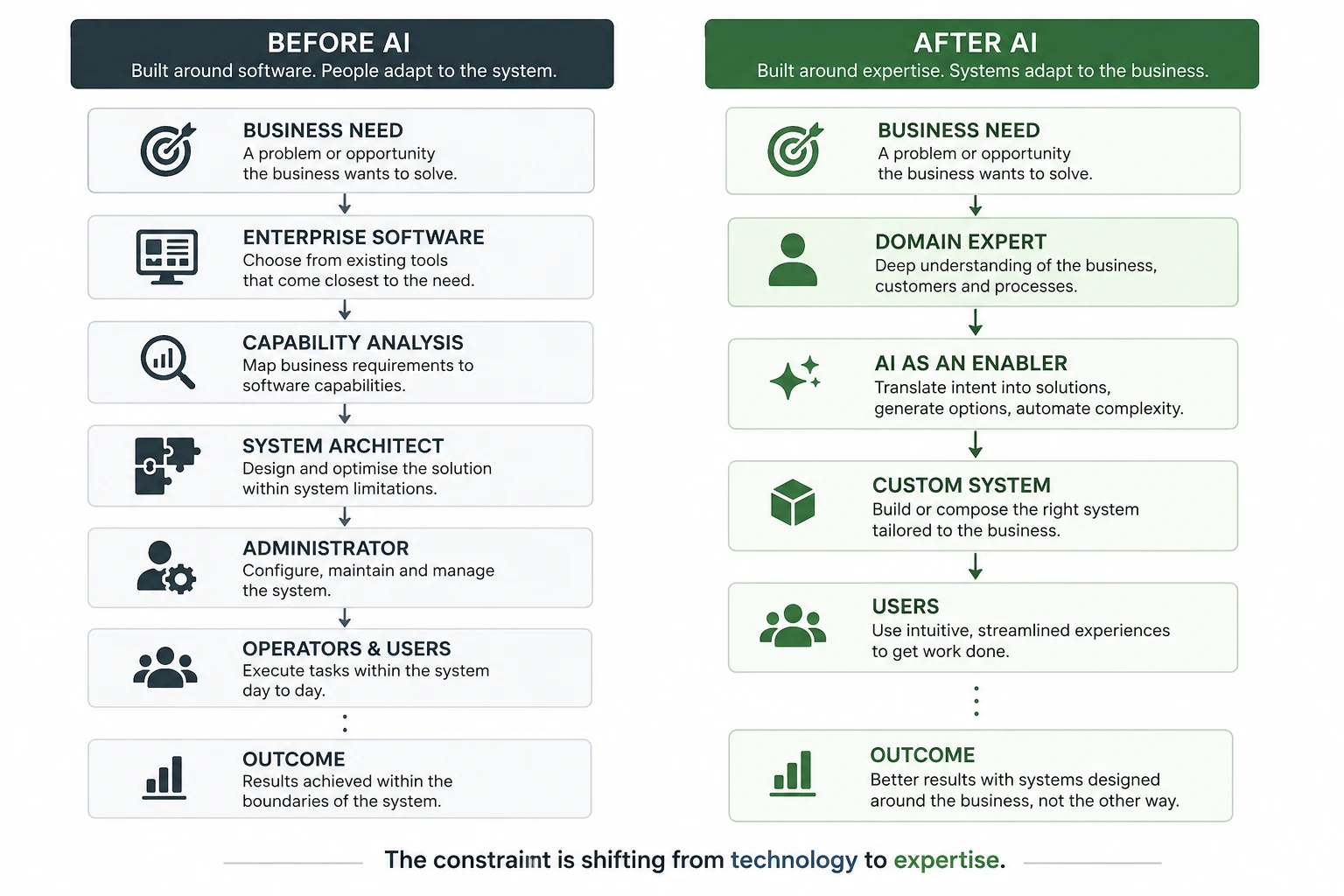
The layers are collapsing. And when the layers collapse, the entire value structure of an organization turns upside down.
The Scarcity Shift
When the layers collapse, the actual execution becomes cheap. AI can write the code, configure the systems, and automate the workflow. It is the ultimate builder.
But a builder still needs a blueprint.
This is where the true scarcity lies. The most valuable people in an organization are no longer the ones who simply execute the tasks. They are the ones with the deep domain knowledge to know what needs to be built, the creativity to structure it, and the understanding of how to actually guide AI to build it.
It is not just general business acumen; it is highly specific domain knowledge. AI can write the code for a CRM or a marketing automation platform in seconds, but only a seasoned marketer understands the nuances of how that tool actually needs to flow to drive customer behavior. AI cannot independently structure a solution. It doesn't know your hidden inefficiencies, your market constraints, or your customers. It needs a director.
- Someone still needs to understand why a process exists in the first place.
- Someone still needs to develop the architecture of the solution.
- Someone still needs to know how to prompt, guide, and constrain the AI to ensure it builds something that actually works in practice.
As AI reduces the friction of creating systems, the bottleneck shifts. It moves away from the people who operate the software, toward the people who have the experience to redesign the business and the fluency to guide AI in building it.
Where the Real Downsizing Happens
This brings us back to the inevitable reality of job loss. The reduction many people expect will happen.
Organisations will need fewer people performing repetitive execution. They will need fewer people maintaining workarounds. They will need fewer people manually moving information between disconnected systems. They may even need fewer software platforms than they rely on today.
But that is not the whole truth.
What they will need more of are the people with deep expertise, strong judgment, and a real understanding of the domain. AI cannot design the solution on its own. It needs someone who understands the problem well enough to shape the architecture, and then steer the AI as it builds.
The scarcity has shifted. For years, technology was the constraint. Now, true expertise becomes the constraint. And when constraints change, value changes with them.
AI is not simply downsizing companies. It is concentrating expertise.
The bloated layers of execution, coordination, and software bureaucracy are thinning out. As they do, the people who actually understand the business gain greater leverage than ever before, because their knowledge can finally be translated directly into systems, workflows, and decisions.
The organisations that succeed in the AI era will not necessarily be the ones with the fewest employees. They will be the ones that strip away the execution layers, and place their most knowledgeable problem-solvers at the center of increasingly intelligent systems.